
The Floor That Kept Lifting — And the Garden That Was to Blame
When a high-quality timber floor began buckling and then settling again, all signs pointed to a product failure. The real answer was found outside the building entirely.
5/17/2026
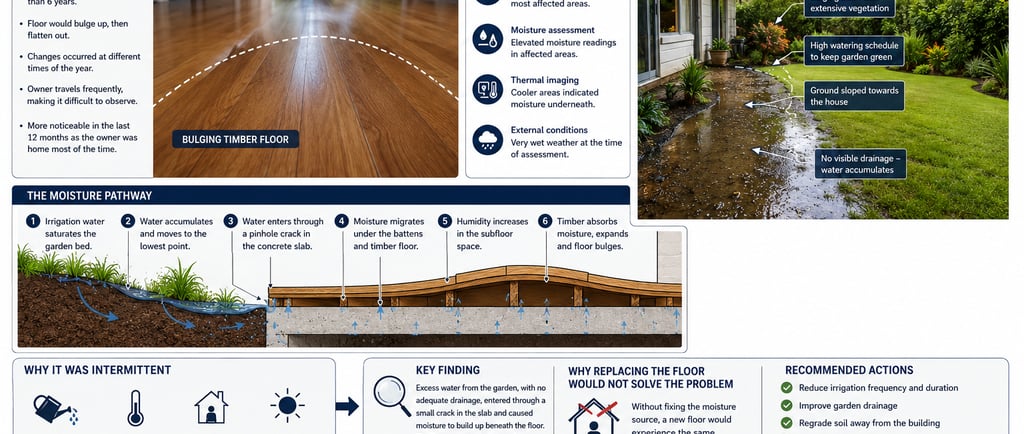
A less-than-six-year-old timber floor, still under installation warranty, was periodically lifting and then flattening with no obvious explanation. The builder was being asked to replace it — but nobody had yet identified the cause. The Wood Floor Drying Team was engaged before any replacement work proceeded.
The pattern that mattered
The movement was seasonal, more pronounced in warmer months, and confined to a distinct line through the home. That line aligned exactly with the external garden bed — the first significant clue. Timber floors don't move randomly. A localised zone of movement almost always points to a moisture source directly beneath it.
What the investigation found
The property had a large irrigated garden adjacent to the affected rooms, with automatic watering running frequently, minimal drainage, and ground sloping toward the building. The owner had increased watering while spending more time at home — unaware that excess water was migrating toward the structure.
How moisture reached the floor
1Irrigation saturated the garden bed
2Water migrated toward the building through the soil
3Entered through a small crack in the concrete slab
4Spread beneath the battens and timber flooring
5Timber absorbed moisture, expanded, and lifted
6Dried between irrigation cycles — and settled again
Thermal imaging identified cooler zones beneath the floor consistent with elevated moisture. Moisture meter readings confirmed the pattern. There was no internal plumbing leak.
Why replacement would have failed
A new floor installed over the same unresolved moisture pathway would have lifted within months.
Timber is hygroscopic — it expands when it absorbs moisture and contracts as it dries. The floor was not defective. It was responding accurately to fluctuating subfloor conditions. The fix was external: reduce irrigation frequency, improve garden drainage, regrade soil away from the building, and allow moisture levels to stabilise naturally.
The owner avoided a costly and unnecessary replacement. Once the moisture source was addressed, the floor was expected to stabilise on its own — no remediation required.
Not all flooring failures are flooring failures. Sometimes the floor is simply the first thing that tells you moisture is entering where it shouldn't.
