
Why a Single-Point Mould Sample Is Often a Limited Approach to Understanding Building and Occupant Issues
Ivi Sims
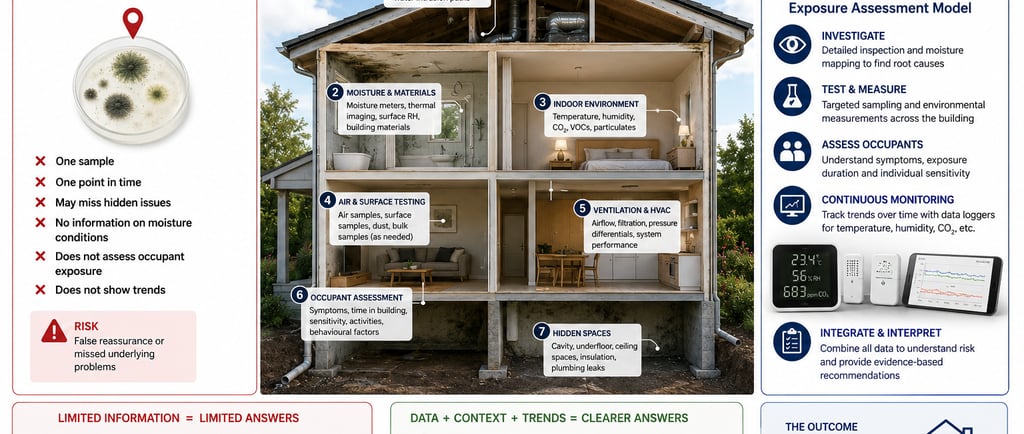
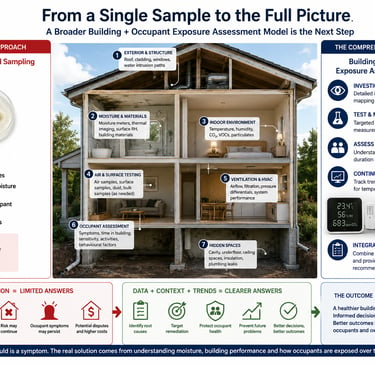
When a mould test comes back, the result is usually brief - "no significant mould detected," or "elevated Aspergillus/Penicillium," or "indoor levels similar to outdoor." These conclusions can feel definitive, but they rarely capture what's actually happening inside a building or how the environment might be affecting the people living and working in it.
At Building Environmental Wellness Group (BEWG), we believe that single-point mould sampling is too narrow an approach to rely on alone. A sample captures one moment in time. It doesn't explain why mould is present, whether the source is active or historical, whether conditions are likely to worsen, or whether hidden growth exists behind walls, under floors, or in ceiling cavities. Because spore release varies with temperature, humidity, air movement, pressure changes, and HVAC operation, a sample taken on the right day can miss the problem entirely.
Mould is a symptom, not the root cause. It grows when moisture conditions allow it to, which means the more important questions are about the building itself - why is moisture accumulating, is the structure drying properly, are surfaces reaching dew point, is ventilation adequate? Without understanding moisture dynamics, sampling is little more than a snapshot.
That said, targeted sampling does have its place. When there's a known water damage event, visible mould growth, a litigation or insurance requirement, or a need for post-remediation verification, laboratory confirmation adds genuine value. But even then, results should be interpreted as part of a broader investigation, not in isolation.
Modern building assessments need to combine building science with exposure science. This means looking at moisture intrusion, condensation risk, HVAC performance, thermal bridging, and drying potential alongside occupant factors like health symptoms, time spent in affected areas, and individual sensitivities. Environmental data, temperature, humidity, dew point, CO₂, particulates, and VOCs - adds further context. Where laboratory testing is needed, it should sit within this wider picture rather than replace it.
What matters most is trends, not single readings. Relative humidity rising above 75% every night, surface temperatures repeatedly dropping below dew point, timber moisture content slowly increasing over weeks -these patterns reveal what a spot measurement will never show. Similarly, a low spore count doesn't always mean low risk, particularly for sensitive occupants where exposure pathway, duration, and individual susceptibility all come into play.
The most defensible investigations bring everything together -detailed visual inspection, moisture diagnostics, thermal imaging, continuous environmental monitoring, ventilation review, occupant interviews, and targeted laboratory testing, all interpre ted by a qualified building scientist. This integrated approach leads to more accurate diagnoses, better remediation decisions, reduced liability, and improved outcomes for occupants.
Overreliance on a single sample can produce false reassurance, miss hidden moisture issues, result in inappropriate remediation, and leave occupant complaints unresolved. The industry is moving beyond "take one sample and hope for an answer," toward integrated assessment that connects building performance, moisture analysis, continuous monitoring, and practical risk interpretation.
At BEWG, our investigations are built around finding root causes rather than simply collecting data. The goal is to understand why a building is creating risk and to provide evidence-based solutions that protect both the structure and the people inside it - because mould is rarely the problem itself. It's the building telling you that moisture management has failed.
